Pigeon Control and Long-Term Prevention for Las Vegas Properties
Pigeon problems in Las Vegas don’t show up overnight, and they rarely go away on their own. The desert climate, the way homes and buildings are constructed, and the steady growth of the metro area all create ideal conditions for pigeons to settle in and stay. Effective pigeon control in Southern Nevada is not just about chasing birds away for a few days. Long-term prevention depends on understanding why pigeons are so persistent here, how they behave in this environment, and what it takes to keep them from coming back once they have claimed a structure as their own.
This page focuses on the long-term control and prevention side of the issue. If pigeons are already established on your roof, under your solar panels, or around key building features, removal may be the first step. Professional services that focus on professional pigeon removal in Las Vegas can address active infestations, but lasting results always come from pairing that removal with properly designed prevention.
Why Pigeon Problems Persist in Las Vegas
Las Vegas provides pigeons with something they cannot easily find in harsher climates: stability. The region’s mild winters and long warm seasons mean that pigeons have access to food, water, and shelter throughout the year. Landscaped neighborhoods, commercial centers, and irrigated green spaces create reliable food and water sources, while the dense mix of residential roofs, parapet walls, signs, and mechanical equipment offers countless places to roost and nest above ground where they feel safe.
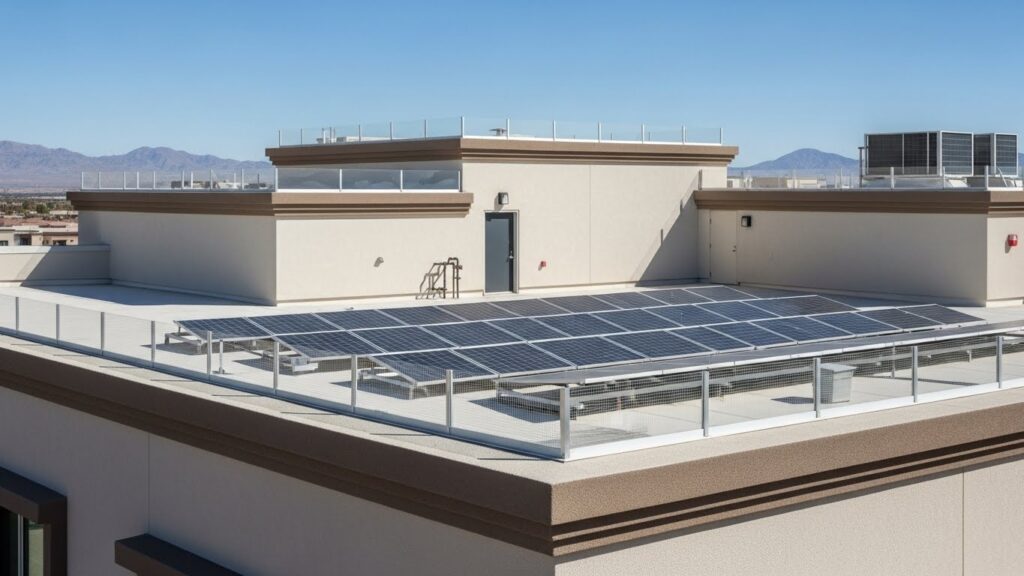
Architecture is a big piece of the puzzle. Many homes across the Las Vegas Valley use flat or low-slope roofs with overhangs, ledges, and equipment platforms. Pigeons look for horizontal surfaces that give them a clear view of their surroundings and some protection from direct sun and wind. Roof-mounted HVAC units, decorative features, and utility runs unintentionally create sheltered corners that are hard to see from the ground but ideal for nesting. The growth of rooftop solar has added yet another layer of shaded, protected space that pigeons can exploit if panels are not properly screened.
Because these building features are built into the way Las Vegas has developed, the pressure from pigeons does not simply disappear when one flock is moved along. New birds find the same advantages, and they will continue to use those structures year after year unless they are intentionally excluded. This is why a one-time response rarely works and why long-term control always comes back to design, prevention, and maintenance.
The Real Risks of Unchecked Pigeon Activity
Structural and Property Damage
Pigeons do not need to tear into materials to cause costly damage. Their impact is gradual, but it is constant. Droppings are acidic and can stain and deteriorate roofing materials, sealants, and finishes. When those droppings accumulate in the same area over time, they hold moisture against vulnerable surfaces and accelerate wear. Nesting materials and feathers can block drains, scuppers, and gutters, causing water to back up and find its way into places it was never meant to go.
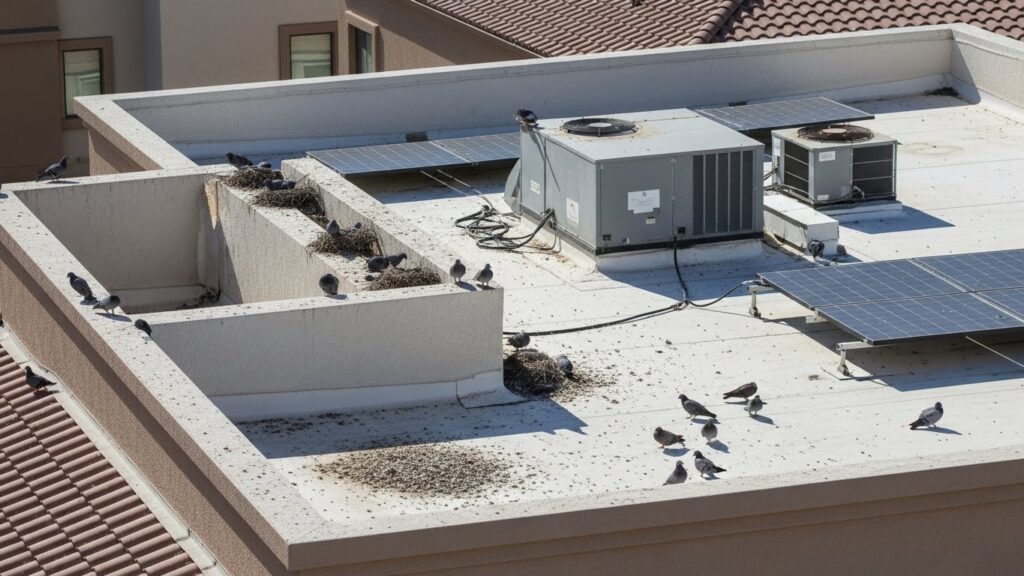
Mechanical equipment is particularly vulnerable. Rooftop HVAC units and associated ductwork provide warmth in winter and shade in summer, making them popular perches. Droppings and nesting debris can obstruct air intakes, slow drainage from rooftop pans, and increase corrosion on metal components. On solar arrays, nesting under the panels traps heat, restricts airflow, and creates an unsanitary mess that can be difficult to access and clean. None of this happens overnight, but over a few seasons the combined impact can shorten the life of roofing systems and equipment and raise repair costs substantially.
Health and Sanitation Concerns
Alongside structural issues, there is a sanitation component that property owners cannot ignore. Pigeon droppings and nesting materials can harbor bacteria, fungi, and parasites. When these materials dry out, they can become airborne as dust, particularly during windy periods or when disturbed during routine maintenance. Areas beneath popular roosting spots become slippery when wet and unsightly when dry, affecting both safety and curb appeal.
For multi-unit residential buildings and commercial properties that see regular public traffic, visible droppings on walkways, entrances, and signage send a clear message about maintenance standards. Even in single-family homes, balconies, patios, and pool decks directly under pigeon perches quickly become unpleasant to use. Long-term prevention deliberately reduces these sanitation issues by limiting where pigeons can settle, not just cleaning up after the fact.
Understanding Pigeon Behavior in Desert Environments
Why Pigeons Choose Elevated and Shaded Structures
Pigeons are ground feeders, but they are rooftop residents. In desert environments like Las Vegas, this behavior becomes even more pronounced. Elevated structures give them a vantage point to watch for predators, people, and other disturbances. At the same time, they need shade and protection from the afternoon sun and from temperature extremes on exposed surfaces. This combination pushes them toward architectural features that provide both height and cover.
Parapet walls, roof returns, sign cabinets, solar panels, and equipment stands all create pockets of shade and shelter. Once pigeons find a comfortable roost with overhead protection and easy access to food and water, they will continue to return to that spot. Over time, that roost can turn into a nesting location, especially if wind, rain, or human activity do not disturb the area consistently. The more that structure mimics a natural ledge or cliff face in terms of security, the more likely it is to be used long term.
Seasonal Nesting Patterns in Southern Nevada
Unlike regions with harsh winters that naturally slow breeding and flock activity, Southern Nevada allows pigeons to remain active for most of the year. There are still seasonal peaks, but there is no true off-season. Warmer weather can lead to more frequent breeding cycles, and food sources remain available around residential neighborhoods, shopping centers, and tourism areas.
This means that property owners in communities such as Henderson, Las Vegas, and North Las Vegas may see activity ebb and flow rather than disappear entirely. In more rural or edge communities such as Indian Springs, Sandy Valley, or Overton, flocks often orient around agricultural areas, utility corridors, and small building clusters but still rely on elevated structures for roosting. Understanding this continuous cycle is key when planning prevention; measures that only address a single season rarely hold up over time.
What Long-Term Pigeon Prevention Actually Involves
Exclusion Versus Temporary Deterrents
Effective long-term control in the Las Vegas area always starts with a simple principle: it is easier to keep pigeons from settling than it is to convince them to leave once they feel at home. Temporary deterrents like noise makers, basic visual devices, or occasional hosing can shift activity for a short period, but they do little to change why pigeons picked the structure in the first place. As soon as the disturbance stops, they often return to the exact same locations.
Exclusion takes a different approach. Instead of trying to scare birds away from attractive ledges and shaded cavities, it removes those landing and nesting options altogether. Properly installed netting, screening, solar panel barriers, and structural modifications make it physically difficult or impossible for pigeons to access the areas they prefer. When those features are combined with a thoughtful review of food and water access, the property becomes much less appealing as a long-term home. In a market where pigeons have many options across neighborhoods like Paradise, Spring Valley, and Enterprise, even modest changes in how inviting a structure feels can shift flock behavior.
Why Prevention Must Match the Structure
There is no single prevention method that works on every building. A small single-story home in Whitney with a simple roofline has a very different profile than a multi-story commercial property in Summerlin South or a mixed-use complex in Winchester. The design of the roof, the presence of solar panels, the number of parapet walls, and the location of mechanical equipment all change where pigeons are likely to land and how they can be effectively excluded.
Long-term prevention plans look at the structure first and then select tools accordingly. On some properties, the emphasis may be on closing gaps under solar arrays and sealing specific roof returns. On others, it may focus on screening off beam pockets, modifying signs, or reinforcing ledges that provide prime roosting spots. When prevention is tailored to the building rather than built around generic products, the results tend to hold up for many more seasons.
When Prevention Alone Is No Longer Enough
Signs of Established Pigeon Activity
Many property owners first think about prevention after pigeons have already established themselves. By the time consistent cooing, scratching, or wing noise is heard from rooflines or soffits, an active roost or nest may already be in place. Heavy, concentrated droppings on the ground, on equipment, or beneath a particular edge are another sign that pigeons have claimed that area for regular use. Nesting materials such as twigs, feathers, and debris collecting in the same general location confirm that the birds are not just passing through.
At this stage, prevention measures alone are rarely enough. Simply adding deterrents or partial exclusion can trap birds in, push them deeper into hidden spaces, or cause them to relocate to another unprotected area on the same property. This is when it becomes important to address the active population directly through removal, and then use prevention to lock in those gains. Professional services that focus on professional pigeon removal in Las Vegas can safely clear out established activity, after which carefully planned exclusion and structural adjustments keep new flocks from taking their place.
Sanitation as a Foundation for Lasting Control
Why Cleanup Directly Affects Reinfestation
Cleanup and sanitation are not just cosmetic steps at the end of a project; they are part of the control strategy itself. Pigeons are guided by scent, sight, and habit. Heavy accumulations of droppings and nesting materials signal that an area has been used safely over time, both to the original flock and to other birds that may be searching for a place to settle. If those materials are left in place after the pigeons are removed, the site continues to advertise itself as a suitable roost.
Thorough sanitation removes more than just the visual mess. It helps reduce odors and organic material that attract insects and other pests, and it improves the safety of areas that people need to access for everyday use or maintenance. On rooftops in communities such as Laughlin, Mesquite, or Moapa Valley, proper cleaning around equipment and drains also supports better water management and prolongs the life of surfaces. When cleanup is treated as a core part of the plan rather than an optional add-on, follow-up prevention tends to perform much better.
How Property Type Influences Prevention Strategy
Residential Properties
Single-family homes and smaller residential buildings across neighborhoods like Overton, Riverside, and Sloan often see pigeon activity centered around specific features: roof peaks, gable ends, covered patios, and solar arrays. Homeowners may first notice droppings on patios or around pool decks, then realize the source is higher up and out of everyday view. Long-term prevention here tends to focus on closing off those favorite high points, limiting access to structural cavities, and making sure birds cannot use the same paths to approach and land.
Because access can be more limited on residential lots, planning also needs to consider how technicians will safely reach affected areas and how solutions will look from the ground. Well-designed residential prevention measures balance effectiveness with appearance so the home looks clean and well maintained without drawing attention to the work that has been done.
Larger and Multi-Structure Properties
Commercial properties and multi-unit buildings in areas such as Enterprise, Paradise, and Spring Valley face a different scale of challenge. Larger roof surfaces, long parapet runs, sign bands, loading docks, and extensive mechanical equipment all create opportunities for pigeons to establish multiple roosting and nesting sites. In these settings, droppings can quickly affect public entrances, sidewalks, outdoor seating areas, and high-visibility signage that carries the brand of the business.
Long-term prevention on these properties often includes phased planning, with the most critical areas addressed first and additional zones covered as budget and access allow. Coordination with property management, tenants, and maintenance teams helps ensure that prevention measures are not disturbed during routine work and that any emerging activity is reported early. Across the wider region, from central Las Vegas to outlying communities like Overton and Mesquite, the most successful commercial strategies treat pigeon control as part of overall property management rather than as a one-time fix.
Long-Term Control Requires Understanding, Not Guesswork
Pigeon control in Las Vegas is not a matter of finding a single product or trick that works everywhere. It is a process that begins with understanding how pigeons use the local environment, how they interact with specific structures, and how their presence changes over time. When prevention is shaped by that understanding—through exclusion, sanitation, and regular review—it becomes much more effective and much more durable.
Whether a property is in the heart of the city, in a growing community like Henderson or North Las Vegas, or in smaller surrounding towns, the principles remain the same. Lasting results come from addressing why pigeons choose a structure, removing the conditions that make it comfortable for them, and maintaining those improvements over time. With a thoughtful approach, long-term prevention can turn a persistent pigeon problem into a manageable part of property care rather than a recurring emergency.